


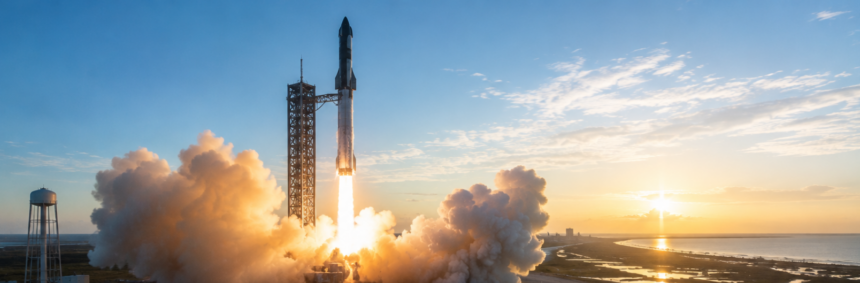
SpaceX Starship V3 Flight 12 launched at 6:30 p.m. local time on 22 May 2026 from the new Pad 2 at Starbase, SpaceX’s company town and launch facility near Boca Chica Beach in South Texas. The vehicle is the most powerful rocket ever built. At 408 feet (124.4 meters) tall, Starship V3 is larger than the Saturn V that sent humans to the Moon. At full thrust, its 33 Raptor 3 engines — and the six on the Ship upper stage — deliver 80,800 kilonewtons of force. The 12th overall test flight of the Starship program, and the first of 2026, arrived after months of delays. It was worth the wait — mostly. SpaceX CEO Elon Musk called it “epic.” He was not entirely wrong.
What’s Happening & Why It Matters
The Thursday Scrub: 40 Seconds to Nothing
The first launch attempt on 21 May ended at the 40-second mark. A countdown that had held steady until that point stopped when a pin holding the launch tower arm in place failed to retract on schedule. SpaceX scrubbed immediately. The next window opened the following afternoon. Teams worked through the night and morning. The Friday launch window at 5:30 p.m. local time (6:30 p.m. EDT / 2230 GMT) was confirmed the following day — and this time the count held.
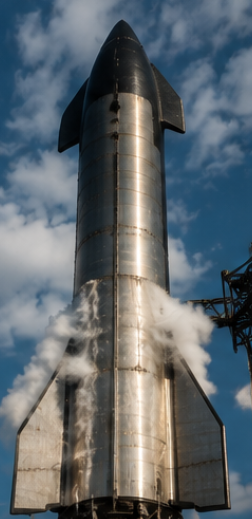
The scrub was the fourth delay in Starship V3’s already lengthy road to the pad. Musk first indicated in January 2026 that the V3 was targeting a March launch. March became April. April became 19 May. 19 May became 21 May when a beach closure was revoked. May 21 became May 22 after the scrub. The pattern reflects the reality of testing radically new rocket hardware. V3 incorporates dozens of structural and engineering upgrades from V2. Those upgrades take time to validate. The launch scrub — despite its proximity to liftoff — is part of the normal rhythm of major rocket development.
What Makes V3 Different From Every Starship Before It
SpaceX rebuilt Starship V3 significantly from its V2 predecessor. The most visible change is scale — V3 stands approximately 16 feet (5 metres) taller than V2. More importantly, the structural changes reduce both weight and manufacturing complexity. The Super Heavy booster uses only three larger, stronger grid fins rather than the four smaller fins on previous versions. The expendable interstage — a ring structure that previously burned up during staging — is replaced by an integrated hot-staging design that eliminates the separate component entirely. Both the booster and ship received simplified aft sections with fewer shrouds and improved thermal protection. New Raptor 3 engines provide higher thrust per unit while weighing less than Raptor 2. The propellant tanks carry more cryogenic liquid oxygen and methane. The new Pad 2 at Starbase includes faster fueling infrastructure and a more durable flame diverter, designed for a higher launch cadence.
The Flight: What Worked, What Didn’t
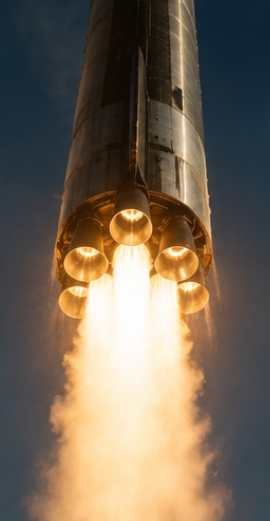
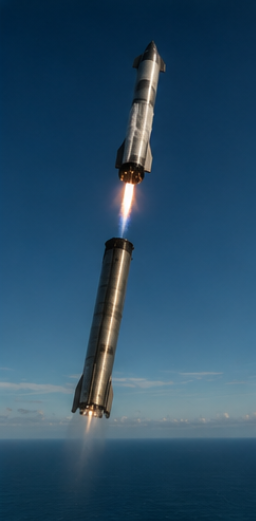
The flight’s outcome is best described as a partial success with a significant asterisk. Super Heavy Ship 39 — the upper stage — performed the majority of its planned objectives. After a successful launch and ascent from the new Pad 2, SpaceX completed hot-stage separation between the booster and the ship. At that point, the booster’s boostback burn — the critical maneuver that redirects the spent booster toward a controlled landing site in the Gulf of Mexico — went off-nominal. Several engines were missing from the burn. The booster began to spin. SpaceX deliberately left the flight termination system inactive. The booster partially recovered control during reentry but the landing burn failed. The Super Heavy entered the transonic regime — crashing into the Gulf of Mexico rather than landing under control.
At the same time, Ship 39 held its trajectory throughout. One of the RVac vacuum engines failed during ascent. By contrast, the sea-level Raptor engines compensated for the lost engine and the ship continued its climb. Ship 39 burned longer than originally planned to adjust for the engine anomaly — and reached its intended suborbital trajectory regardless.
The Mission: 22 Satellites, Re-entry, Indian Ocean
Once Ship 39 reached its planned trajectory, the mission’s secondary objectives proceeded. The ship deployed 22 Starlink simulator satellites — full-scale mockups of the next-generation Starlink V2.5 satellites that Starship’s payload bay is designed to carry at volume. Each simulator matches the mass, size, and centre-of-gravity profile of a real Starlink unit. At the same time, SpaceX aborted the planned engine relight — which would have tested orbital insertion capability — because of the anomalies experienced earlier in the ascent. That decision reflects mission management discipline. The relight would have been data-rich if attempted successfully. Under the circumstances, protecting the remaining mission objectives was the right call.
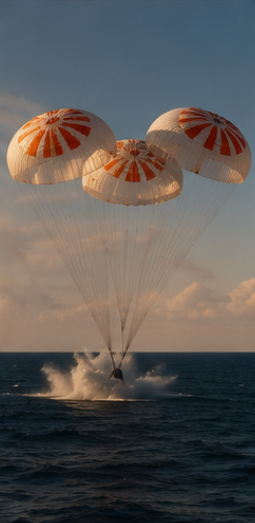
Ship 39 then executed the most demanding phase of any Starship mission — atmospheric re-entry. Previous Starship iterations had encountered significant challenges during re-entry, including loss of control and structural damage. V3 completed reentry and splashed down in the Indian Ocean as planned. Musk said after the flight that V3 had survived re-entry with all critical systems intact.
The IPO Timing on the Launch
The launch timing carries commercial significance beyond the engineering. As TF covered in its earlier article on the SpaceX IPO filing, SpaceX is targeting a Nasdaq listing in June 2026 under the ticker SPCX, targeting a $1.75 trillion (€1.61 trillion) valuation. The S-1 filing explicitly listed Starship delays as the primary risk factor. A successful Flight 12 — even one with a lost booster — directly mitigates that risk in the minds of prospective investors. Starship V3 can fly. It can reach space. It can survive reentry and deploy a payload. That is the baseline that every forward IPO projection requires. SpaceX needed V3 to fly before the June roadshow. It flew with ten days to spare.
The Surprise Mars Fly-by Announcement
Flight 12’s pre-launch coverage included a surprise announcement from SpaceX. Chun Wang — the cryptocurrency billionaire who commanded the Fram2 private Dragon mission in 2026 — was announced as the commander of the first Starship flyby of Mars. The mission will swing by the Moon. Wang confirmed the mission’s scope directly. “It’s going to be a flyby mission of Mars. A lot of people talk about Mars. We like Mars, we’re gonna land on Mars.” The Mars flyby does not have a confirmed launch date. It represents a significant step toward human Mars exploration that does not require Starship to land or operate on the Martian surface — making it technically achievable earlier than a full crewed landing mission.
Beyond the IPO: NASA, Artemis, and Flight 12
The most consequential audience for Flight 12’s results is not IPO investors. It is NASA. NASA has selected Starship as the Human Landing System for Artemis IV — targeting a crewed Moon landing in 2028. To fulfil that contract, SpaceX must demonstrate a full orbital flight, in-orbit propellant transfer between two Starships, docking with an Orion capsule in lunar orbit, and a controlled landing on the lunar surface. None of those capabilities has been demonstrated yet. Flight 12 does not deliver any of them directly. By contrast, it delivers something that every subsequent test builds on — proof that V3 can fly, survive re-entry, and deploy a payload under engine-out conditions.
The Artemis IV timeline creates non-negotiable milestones for SpaceX. In-orbit refueling has never been attempted with cryogenic propellants at Starship’s scale. The tanks required for that maneuver were first fitted to V3 hardware in Flight 12’s configuration. Flight 13 — targeting June 2026 — will build on Flight 12’s data.
TF Summary: What’s Next
SpaceX will analyse the Flight 12 data from both the successful Ship 39 trajectory and the lost Super Heavy booster. The boostback burn anomaly is the primary focus of the investigation. Flight 13 — targeting June 2026 from Starbase Pad 2 — will aim to resolve the boostback failure and attempt the engine re-light that Flight 12 aborted. The Starbase Pad 2 flame diverter performance will be evaluated — a key metric for assessing whether the new infrastructure supports the higher cadence SpaceX needs to achieve its Artemis timeline.
MY FORECAST: SpaceX Starship V3 Flight 12 will be remembered as the flight that validated the V3 architecture — not as the flight that solved every problem. The booster loss is significant but recoverable. SpaceX‘s booster recovery track record on previous flights — including multiple successful catch attempts at Pad 1 — means the Pad 2 infrastructure will be refined for Flight 13. The engine-out performance of Ship 39, by contrast, is genuinely impressive. A rocket that can lose an engine, extend its burn, and reach its planned trajectory represents a meaningful step in operational robustness. By Q4 2026, Starship V3 will have completed at least two more test flights. By the time the Artemis IV target year arrives in 2028, orbital flight will be demonstrated — though the in-orbit refueling demonstration is the milestone with the least margin for delay.
Related Stories
INTERNAL LINK SUGGESTIONS:
- Link “SpaceX IPO filing” via “As TF covered in its earlier article on the SpaceX IPO filing” → https://techfyle.com/spacex-ipo-filing-starlink-revenue-valuation-2026
- Link “SpaceX News: IPO Powers, New Rockets, DCs, and Anthropic” via “Starship V3 completed a full-duration static fire in April 2026” → https://techfyle.com/spacex-news-ipo-terafab-anthropic-colossus-2026
- Link “Starlink subscribers” via “Starlink serves more than 10.3 million subscribers” → https://techfyle.com/starlink-gps-location-removal-api-change-2026