


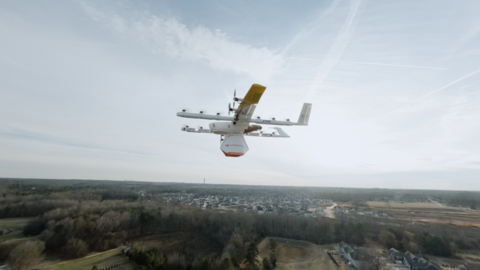
Atlanta traffic has bullied drivers for years. DoorDash and Wing want to fly lunch right over the mess.
DoorDash is bringing drone delivery to metro Atlanta, and the move is not some citywide sci-fi takeover. The rollout is limited, targeted, and very deliberate. Eligible customers near Tanger Outlets, Locust Grove, can order from select restaurants through the DoorDash app and, if the order fits the rules, choose Wing drone delivery instead of a driver.
That may sound like a small test. Small tests are often where the real market story begins. DoorDash is not launching drones in Atlanta because executives got bored and wanted louder headlines. The company is doing it because suburban sprawl, traffic pain, short-distance food runs, and a maturing drone partner finally make the math worth trying. The promise is simple: faster local deliveries, less road friction, and a fresh pitch for “autonomous delivery” that sounds more useful than futuristic.
What’s Happening & Why This Matters
DoorDash Atlanta’s Growing Drone Map
DoorDash’s new Atlanta-area launch expands the company’s partnership with Wing, Alphabet’s drone-delivery unit. The service is active in Locust Grove, a suburb south of Atlanta, rather than in the city core. That choice is not random.
Dense downtown airspace comes with more complexity, more regulation, and more obstacles. Suburban zones offer a cleaner proving ground. Homes are spread out. Drive times are often annoying, even over short distances. Parking and pickup friction still wastes time. A drone can solve a very particular problem in places like that.
Eligible customers near the shopping center can open the DoorDash app, spot the drone-delivery option, and order from participating restaurants. Early restaurant partners include Molinos Mexican Grill, Koji Japanese Steakhouse, and Sabrosos Mexican Restaurant. That list may grow, but the initial mix says enough already. DoorDash is starting with meals that fit the weight, packaging, and time window a drone service can actually handle.
This is not the first time DoorDash and Wing have worked together. The pair already operate in parts of Southwest Virginia, Dallas-Fort Worth, and Charlotte. Atlanta adds another metro region to a slow but very intentional expansion path. The companies are not pretending that drones can replace the whole delivery fleet tomorrow. They are trying to prove that enough small runs can move off the road.
Fast Service, Tight Boundaries
Drone delivery sounds magical until you understand the limits. Then it starts logistics with propellers.
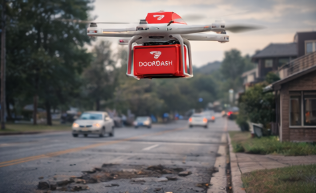
Orders must comply with Wing’s weight and packaging rules. Customers must be within the eligible delivery zone. The delivery address must work for a safe drop. The weather has to cooperate. The order has to come from participating merchants. Not every burrito gets wings.
When it does work, the value pitch is strong. The companies say some deliveries can arrive in as little as 20 minutes. That speed in a metro area where a short drive can turn into a small life event the moment traffic thickens.
The drone is not in the customer’s hand like a movie prop. Wing lowers the package by tether, releases it at the drop point, and heads back out. That method reduces landing risk and helps the system operate more consistently across homes and yards without needing a huge clear pad.
The boundaries may frustrate people who want instant universal coverage. Fine. Boundaries are exactly why the launch sounds credible. DoorDash and Wing are not claiming they solved every delivery problem. They are aiming at a smaller set of orders where the economics and operations have a chance to work.
That is much smarter than promising the Jetsons and delivering a press release.
Traffic Is the Product Problem
The companies are clearly betting on one core pain point: traffic.
Metro Atlanta has a long, ugly relationship with road congestion. Even a quick restaurant run can go sideways once cars start stacking up around retail corridors, school routes, and commuter arteries. DoorDash and Wing are not trying to eliminate that reality. They are trying to route around it.
Food delivery often falls apart on the smallest inefficiencies. A driver waits for pickup. A customer is only a few miles away. The route is easy. Then traffic turns a short run into an annoying one. The result is slower delivery, colder food, and worse unit economics.
A drone can cut through that mess in the right order. The value is not only speed. The value is reliability. A company can tolerate a limited delivery model if the limited model solves exactly the jobs that standard road delivery handles poorly.
That is why the suburban setup is crucial. Locust Grove is not some consolation prize. It is the point. Highly car-dependent communities with short local delivery radii create the kind of operating environment where drones can stop sounding gimmicky and start sounding practical.
The point is here. DoorDash is not testing whether drones are cool in Atlanta. DoorDash is testing whether it can beat Atlanta-area road traffic more often than not.
Wing Is the Backbone
DoorDash gets the food app headlines. Wing deserves more attention than it usually gets.
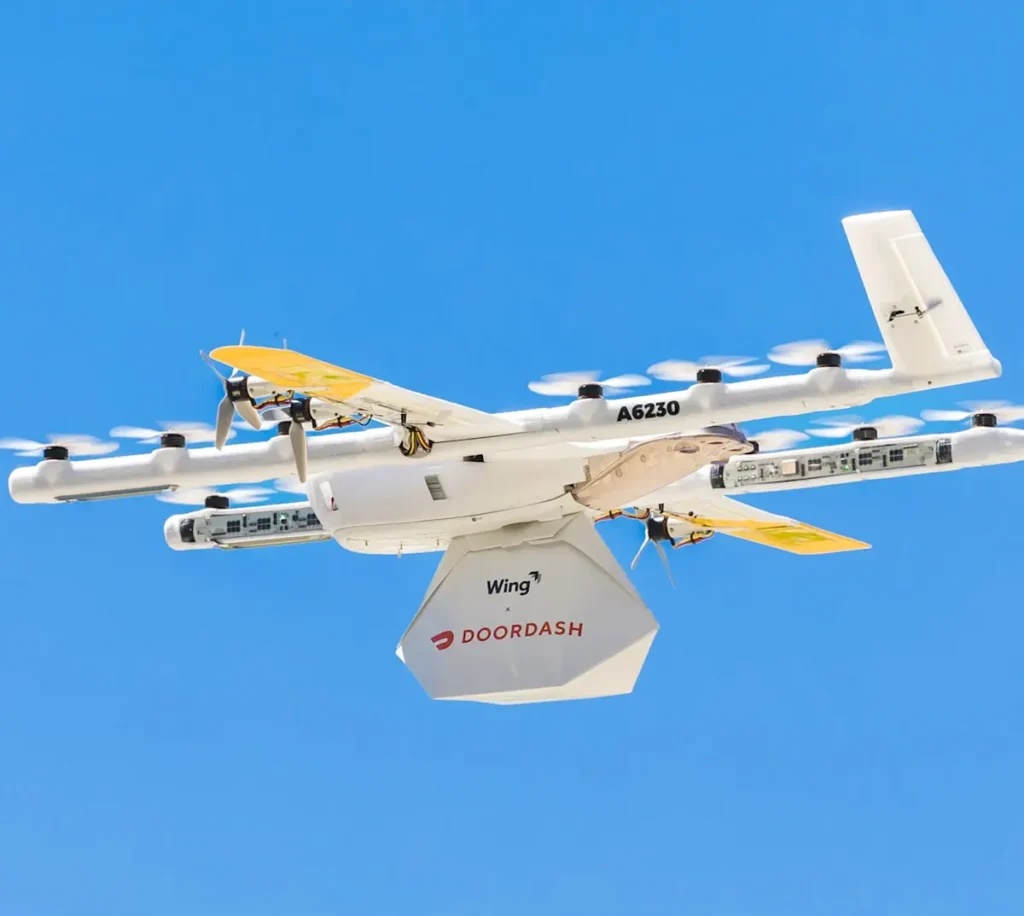
Wing has been building toward this for years. The Alphabet-owned company has logged hundreds of thousands of deliveries across multiple markets and has steadily refined the kind of last-mile network it wants to run: small packages, local merchants, light payloads, short delivery windows, and highly automated operations.
That makes Wing a good match for DoorDash. Food delivery needs frequent, short, repetitive runs. Drone economics only work when the network can do that safely and repeatedly without turning each order into an expensive experiment.
DoorDash’s own statement around the Atlanta launch views autonomous delivery as part of making local commerce “faster, more delightful, and more sustainable.” That phrase is polished, but the business logic underneath is plain. If a drone can handle a subset of deliveries more cheaply, more quickly, or more reliably than a car-based courier, then the service gets strategic value.
Wing is not merely a novelty vendor in that equation. Wing is the operational engine that gives DoorDash a chance to test whether aerial delivery can carve out a durable slice of the local-commerce stack.
That is the long game. DoorDash wants the customer relationship. Wing wants the sky route.
A Small Launch with Serious Ramifications
A limited launch in one Atlanta suburb is easy to shrug off. That would miss the larger point.
Drone delivery has spent years stuck between hype and skepticism. Some people talk as if drones will replace half the delivery economy. Others treat the whole category like a noisy toy for trade-show demos. The truth is much less dramatic and much more important.
Drone delivery is likely to win in narrow lanes first.
Small food orders. Light retail runs. High-friction suburban traffic. Locations where a customer is close enough for a drone to save time but far enough that a driver still burns too much road effort. That is where the category can prove itself.
The Atlanta rollout fits that theory perfectly. DoorDash and Wing are not trying to conquer all of last-mile logistics in one move. They are trying to take a bite out of the part of the problem that is most solvable.
If enough of those bites work, the category grows from there.
The outcomes go beyond a single shopping center and a few restaurant partners. A lot of real technology adoption does not begin with universal domination. It begins with one annoyingly effective use case that no longer sounds ridiculous after people use it twice.
Scale, Noise, and Regulation
The drone dream still has enemies.
Noise complaints can sour neighborhoods quickly. Airspace rules are strict. The weather is a recurring nuisance. Delivery zones need careful design. Merchants need packaging that works. Customers need yards or drop spaces that meet safety requirements. Regulators still do not hand out trust like party favors.
Then there is the economics question. Limited drone delivery is exciting as a pilot and disappointing as a business if the network cannot achieve sufficient density in each zone. One drone run may impress. A durable system needs frequency, uptime, merchant adoption, and enough customer demand to justify the infrastructure behind it.
DoorDash and Wing know that. That is probably why the launch sounds so disciplined. They are not trying to sell Atlanta a fantasy of instant citywide aerial delivery. They are running a narrow service where the chances of success are higher, and public blowback is easier to manage.
That caution is a strength, not a weakness.
A lot of autonomous delivery stories fall apart because companies speak like prophets and operate like interns. This one sounds more grown-up. Limited zone. Specific merchants. Known partner. Real traffic pain. Real product constraints. That is a much healthier recipe.
What “Delivery” Means Next
The Atlanta drone rollout is not only a logistics story. It is a definition story.
For years, “delivery” has meant a person in a car, on a scooter, or on a bike bringing goods across roads. That model is still dominant, and it is not disappearing tomorrow. Yet the category is starting to split.

Ground robots will handle some short sidewalk runs. Human couriers will keep doing plenty of the complex, messy, high-touch work. Autonomous cars may take on certain middle-mile and last-mile tasks. Drones will carve out their own zone where speed, weight, distance, and traffic align in their favor.
DoorDash is not only adding a feature. DoorDash is helping train customers to think differently about what kind of machine might deliver dinner.
Once that mental shift happens, the market gets more interesting. The question stops being “Can drones deliver food?” The question is “Which deliveries still make sense on roads?”
That is a much bigger question.
TF Summary: What’s Next
DoorDash’s limited drone delivery launch in metro Atlanta adds another real-world test to a category that has spent too long bouncing between hype and doubt. Eligible customers near Tanger Outlets Locust Grove can order from a small group of restaurants and, if the order fits the rules, receive food by Wing drone in as little as 20 minutes. The move expands an existing DoorDash-Wing network that already operates in parts of Virginia, Dallas-Fort Worth, and Charlotte.
MY FORECAST: Drone delivery will spread in narrow suburban corridors before it ever tries to dominate dense urban cores. The winners will not be the firms with the loudest futuristic ads. The winners will be the firms that quietly solve ugly local logistics problems over and over again. Atlanta is not the finish line. Atlanta is another proof point in a market that is slowly learning where drones are genuinely useful and where they are still just loud little fantasies.
— Text-to-Speech (TTS) provided by gspeech | TechFyle