


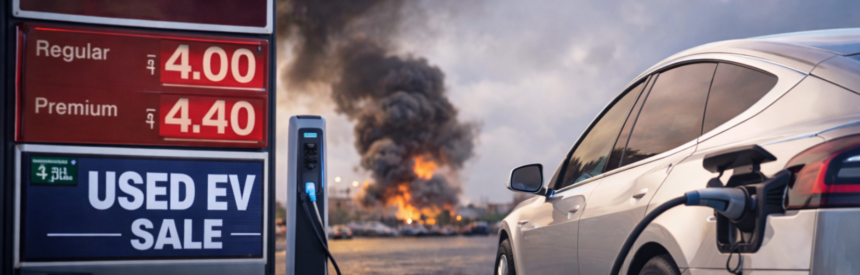
Nothing sells an electric car like a war crushing the petrol prices and availability.
The latest surge in used EV sales is not due to the car industry suddenly finding religion. The jump is coming because petrol prices have climbed hard after the Iran war and the resulting shock around oil flows through the Strait of Hormuz. Buyers who ignored electric vehicles a few months ago are suddenly staring at fuel bills, doing rough maths, and deciding a used battery-powered car sounds a lot less weird than another year chained to the pump.
That reaction says plenty about how the EV market really works. For years, politicians, automakers, and culture warriors argued about climate targets, charging networks, tax credits, and whether electric cars felt exciting enough. Fair. Yet nothing cuts through the noise faster than a direct punch to household fuel costs. When petrol spikes, ideology gets quieter. Monthly payments start doing the talking.
What’s Happening & Why This Matters
Used EVs Boom Is Not a Clean Energy Revival
The first correction worth making is simple. The hottest part of the market is used EVs, not some glorious across-the-board electric comeback. New EV sales have taken a beating in the United States after the Trump administration scrapped the $7,500 (€6,900) consumer tax credit, and several automakers have already scaled back or delayed electric plans.

The used side tells a different story. Cox Automotive data cited in the current report show that first-quarter used EV sales rose 12% year over year to about 93,500 units. Quarter over quarter, used EV sales rose about 17% from the fourth quarter into the first quarter. That sort of move is not a rounding error. That is a market reacting to conditions with speed.
The immediate driver is petrol pain. Reporting says U.S. average fuel prices have climbed above $4 per gallon, while some states are much worse. California has approached $5.89 per gallon, or about €1.43 per litre. Texas sat closer to $3.68 per gallon, or about €0.89 per litre, yet even there, used EV dealers reported a rush of interest.
So yes, the title carries heat. The sharper version is even more useful: the Iran war has spiked used EV sales because fuel costs finally made the old EV cost argument personal.
Cheap Used EVs at Exactly the Right Time
Fuel prices alone do not explain the bump. Supply is doing heavy work, too.
Hundreds of thousands of leased EVs from the early 2020s are returning to the market. That growing supply has lowered prices and brought used EVs closer to parity with internal-combustion vehicles. Cox Automotive says the average used EV sold for roughly $34,821 (€32,100), compared with about $33,487 (€30,900) for a comparable gas vehicle. That gap is small enough to stop sounding like a barrier.

That is the ugly little irony for legacy automakers. The same industry that spent years telling buyers to wait for EV affordability is finally getting some traction because lease returns are flooding the secondary market. Cheap used Teslas, Hyundais, Kias, Chevrolets, Polestars, and Nissans are doing much of the persuading that polished marketing campaigns never managed.
Buyers are responding because the value proposition has grown clearer. The upfront difference between used EVs and gas cars is shrinking. The monthly fuel bill for a gas car is rising. Maintenance is still lighter on the EV side. Suddenly, the old objections sound a lot softer.
A culture-war fight can drag on for years. A used-car lot full of cheaper EVs can settle arguments on a Saturday afternoon.
The Pump Shock Is Real
For years, EV adoption depended heavily on subsidies, incentives, and political incentives. Governments offered tax credits. States added rebates. Utilities tried to sweeten home-charging economics. That whole structure always carried one weakness: many buyers saw the help as artificial.
A petrol shock changes the emotional equation. Nobody needs a climate lecture when the cost of filling a tank has surged again. Nobody needs a long policy memo when a commuter realises the family budget is bleeding cash into the forecourt.
That is why the spike in used EVs is so instructive. The market is showing what really moves mainstream behavior. A lot of people do not wake up wanting an electric car because the drivetrain seems morally cleaner. A lot of people wake up wanting a cheaper month.
The same point helps explain why used EVs are outperforming new ones. A price-sensitive buyer seeking relief from fuel spikes is not shopping for a shiny luxury EV with every option box ticked. That buyer is hunting for a deal that cuts costs fast. Used EVs fit that moment much better than expensive new inventory.
Here is the rude truth the industry keeps learning: affordability wins converts faster than evangelism.
Energy Security Is Consumer Security is National Security
A geopolitical angle is underneath the sales bump. The Iran war and the disruption around the Strait of Hormuz are not just abstract foreign-policy headlines. They are turning energy security into a consumer issue again.

The Strait is one of the world’s most critical oil chokepoints. Once traders and refiners start worrying about supply disruptions, the pressure moves quickly through global markets and then straight into local fuel prices. That means a family in Texas, California, or Sydney can feel the economic sting of a conflict thousands of miles away without knowing much about maritime logistics or tanker insurance.
Electric vehicles start looking different in that atmosphere. A used EV is more than a car purchase. A used EV starts resembling a hedge against geopolitical mess. Home charging, workplace charging, or cheaper grid electricity is safer than relying on a commodity market, one missile strike away from another spike.
That does not mean every buyer is suddenly thinking like an energy strategist. Most are not. Most are just sick of watching petrol prices act like a hostage negotiation. Still, the practical outcome is the same. Energy instability makes electrification more attractive.
The old EV slogan was often environmental. The new one is creeping toward something more ruthless: fewer shocks from oil chaos.
Dealers Are Benefiting
Used EV dealers are enjoying the moment. Some independent sellers say inquiries and trade-ins have climbed rapidly. Rental and peer-to-peer markets have seen increased demand for electric and hybrid vehicles. In Australia, EV and hybrid rental bookings reportedly rose by about 70% year over year amid fuel disruptions that disrupted Easter travel plans. Consumer loan demand for EVs jumped sharply there as well.

Yet the wider industry is not cruising comfortably. New EV production has slowed. Federal support in the U.S. has weakened. Some automakers have cut models or softened rollout plans. The used market is strong because buyers want affordability, not because the whole EV ecosystem has reached some glorious friction-free maturity.
A spike in used EV sales is good news for electrification, but the story is not a full victory lap. Manufacturers still face margin pressure, infrastructure gaps still annoy drivers, and political hostility toward EV policy has not disappeared.
The more interesting lesson is elsewhere. Even in a rough policy climate, market logic can still drive EV adoption forward when alternatives start to hurt more.
Can Used EVs Reset the Public Story on Electric Cars?
The culture around EVs has been warped for years by a noisy debate that confuses politics with practicality. One side treated EVs as moral salvation on wheels. The other side treated them as elite gadgets or ideological props. Neither side captured the used-car lot very well.
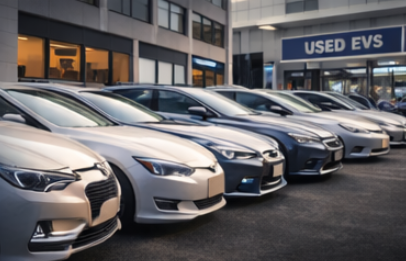
Used EVs are different. A secondhand electric crossover with falling prices and lower operating costs is not a luxury fantasy. A car like that appears as an ordinary household expense. That is where the public story could change.
A buyer who never cared about battery chemistry, carbon targets, or Elon Musk may still decide a used EV makes sense because the fuel alternative has grown stupidly expensive. Once enough buyers make that jump, public perception changes. Electric cars stop being a niche political statement and achieve a sensible transport status in a volatile world.
That kind of perception shift carries more long-term value than a thousand online arguments. Once EVs move from “aspirational tech object” to “cheap way to avoid petrol pain,” the market gets a lot harder to bully backwards.
That may be the most important part of the whole story.
TF Summary: What’s Next
The Iran war has helped drive petrol prices higher, and the strongest market response has appeared in used EV sales rather than a broad-based rebound in brand-new electric cars. More off-lease supply has lowered prices. Fuel costs have risen enough to make electric ownership more practical. For many buyers, the question has stopped sounding ideological and started sounding brutally simple: why keep feeding an expensive tank when a cheaper used EV is sitting nearby?
MY FORECAST: Used EV demand will stay stronger as long as fuel prices stay elevated and lease-return inventory keeps flowing. The market will likely draw more skeptics into battery-powered vehicles through price logic rather than climate rhetoric. Automakers will take the lesson to heart, even if some hate the reason. A war-driven oil shock has done more to normalise buying used EVs than years of polished speeches ever have.
— Text-to-Speech (TTS) provided by gspeech | TechFyle