


Not a mere birthday story. It is a half-century of one company’s polished hardware with cultural muscle.
Apple turned 50 on 1 April 2026, and the milestone is marked with a strange mix of nostalgia, swagger, and fresh pressure. The company began in 1976 in the Los Altos garage, lore that tech historians will never stop recycling. It nearly collapsed in the 1990s. It returned under Steve Jobs, then, under Tim Cook, expanded into the most valuable public company on Earth, reaching nearly $4 trillion (€3.7 trillion) in market value. Apple has achieved such heights while still selling phones, laptops, watches, earbuds, and services — at absurd scale.
That arc is why Apple still pulls so much attention. It did not merely build products. It kept redefining what mainstream consumers expect from computers, music players, smartphones, wearables, and digital ecosystems. At the same time, the company enters 50 with an awkward question hovering above the candles: can an icon keep shaping the future once the future turns hard toward AI?
What’s Happening & Why This Matters
Apple’s Origin Story Still Shapes Its Brand
Apple’s founding myth is one of the strongest in technology. The company says its story begins on 1 April 1976, driven by the belief that people who challenge convention can change the world. That definition still fuels its brand voice today. It sells Apple as the company that made technology feel personal rather than corporate.
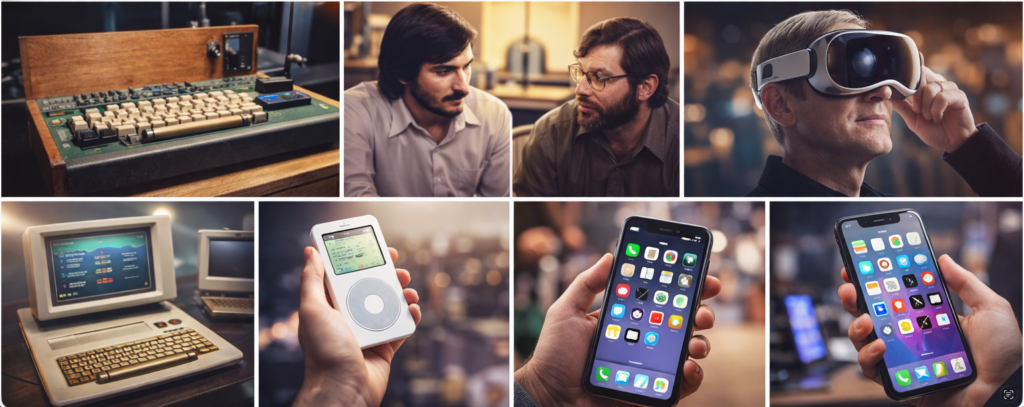
The early products built that reputation fast. The Apple I introduced the garage legend. The Apple II turned that spark into a commercial success. The Macintosh in 1984 gave Apple something even more powerful than sales: identity. The Mac helped make graphical computing approachable. It wrapped technology, design, and attitude all at once.
Apple’s brand history is not built only on specs. It is built on emotional continuity. Consumers do not merely buy a device. They buy the idea that Apple smooths complexity, trims ugliness, and turns hard tech into a daily habit. Plenty of rivals copied the style. Few matched the aura.
That aura has survived because Apple’s early years taught the company a brutal lesson. Hardware alone is forgettable. Hardware with taste can become myth.
Apple Nearly Died, Then Jobs Returned and Reset the Script
The neat anniversary version of Apple history loves the heroic rise. The messier version is better. Apple stumbled badly in the 1990s. Product lines sprawled. Strategy drifted. Microsoft dominated computing. The company flirted with irrelevance and, at moments, something close to corporate death.
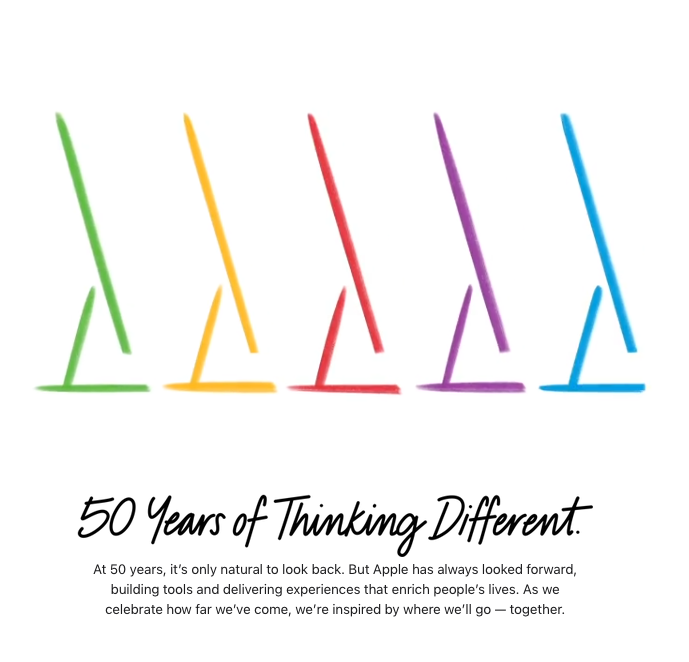
Then Steve Jobs returned in 1997 after Apple bought NeXT. That comeback is one of the most over-told stories in tech, and it still deserves attention. Jobs cut products, narrowed focus, and rebuilt the company around clarity. The iMac in 1998 helped restart Apple visually and commercially. Bright colour, simple setup, and unapologetic style helped show that computers did not need to resemble beige office bricks.
The return did more than save the balance sheet. It restored Apple’s nerve. From that point on, the company stopped acting like a struggling PC maker and started behaving like a category builder. That shift set the stage for the next wave of products that would define the brand for millions who never touched an Apple II or an early Mac.
The company’s near-collapse almost wrote its final chapter. But now at 50, it makes the mythology honest and vibrant. Apple did not glide from garage to glory. It hit the wall, then rebuilt.
iPod and iPhone Turned Apple Into a Consumer Giant
If Macintosh made Apple famous, iPod and iPhone made it dominant. The iPod launched in 2001 and changed portable music by blending hardware, software, and a clean user experience. It did not invent MP3 players. It simply made them feel finished. That pattern is classic Apple.
The bigger shock arrived in 2007 with the iPhone. Tony Fadell has recalled the company’s fear clearly: people would carry one device, not two. Apple had to decide whether to protect the iPod or replace it. It chose replacement, which changed the company and the wider industry. By April 2004, the iPod was already outselling the Mac and growing more than 900% from a year earlier. Apple still chose disruption over self-protection.
That choice matters at 50. The firm repeatedly proved willing to eat its own winners before rivals did. The iPhone then became the company’s largest product by far and reshaped communication, software distribution, photography, payments, and mobile computing.
The iPhone was not simply a smash. It was the device that turned Apple from a beloved tech company into a cultural utility.
Tim Cook Scaled the Empire Beyond Steve Jobs
Steve Jobs is the real legend, but Tim Cook built the longer commercial machine. After Jobs died in 2011, plenty of critics wondered whether Apple would drift into safe repetition. Instead, Cook expanded the company into a more disciplined giant.
Under Cook, Apple deepened services through the App Store, Apple Music, iCloud, Apple Pay, and Apple TV+. It jumped into wearables with Apple Watch and AirPods. It strengthened Apple silicon, which gave the Mac new life and better battery performance. It kept the ecosystem tighter and more profitable.
That strategy helped Apple approach roughly $465 billion (€430 billion) in annual revenue, according to Reuters’ anniversary coverage. The company’s services business became a major engine rather than a side dish. Its hardware ecosystem grew stickier. Its margins stayed enviably strong.
Critics still argue Apple, under Cook, is more polished than daring. There is some truth there. Yet scale is its own kind of daring when done without blowing up brand trust. Cook did not need to imitate Jobs’ theatre. He built a supply-chain fortress, a services machine, and a cash-generating empire that made Apple sturdier than ever.
That is less romantic than the garage tale. It is still how icons survive.
At 50, Apple’s Next Test Is AI, Not Memory Lane
Anniversaries tempt companies to stare backwards. Apple’s own messaging still leans toward the future. Tim Cook said “thinking different has always been at the heart of Apple” and that the company stays focused on what comes next. Fine words. The harder question is whether Apple can still lead the next revolution, rather than polish its way through it.
That shift is AI. Rivals such as Alphabet, Microsoft, and OpenAI are racing hard. Apple has added AI capabilities for years, yet it has looked slower and more cautious in the current generative wave. Reuters noted concern over the pace of Siri’s deeper AI evolution, even as Apple keeps stressing privacy, accessibility, and on-device intelligence.
The risk for Apple is not collapse. It is drift. A company can keep printing money and selling iPhones and still lose cultural gravity if it is late to the next platform shift. The company’s defenders will argue Apple often enters markets after the noise and wins with better execution. Fair point. Yet AI is not only another feature race. It may reshape operating systems, search, creativity, assistants, and hardware itself.
So, at 50, Apple is in a strong but uncomfortable place. It is one of the cleanest product companies in history. It still commands immense loyalty. It still turns design into margins better than almost anyone. Yet the next chapter will ask whether the icon can define a new era rather than merely curate one.

TF Summary: What’s Next
Apple’s first 50 years tell a rare story in tech. The company began as a garage upstart, nearly fell apart, was rebuilt under Steve Jobs, and expanded into a global consumer empire under Tim Cook. Along the way, it made the Mac, iPod, iPhone, Apple Watch, and a wider hardware-software-services ecosystem that changed how people work, listen, communicate, and pay. Very few companies get to shape that many habits across that many decades.
MY FORECAST: Apple will keep selling polished hardware and sticky services at serious scale, but the next reputation test will come from AI. The company does not need to win every benchmark. It needs to prove it can still define the feel of the next computing era. At 50, Apple has already won history. The next fight is whether it can still win the mood of the future.
— Text-to-Speech (TTS) provided by gspeech | TechFyle