


Global Leaders Debate Control, Risk, and the Future of Artificial Intelligence
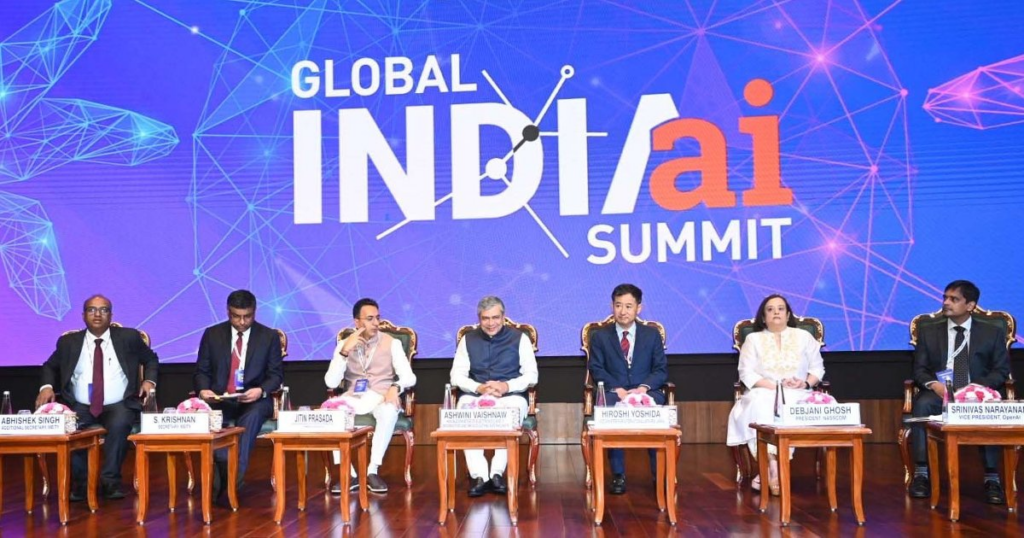
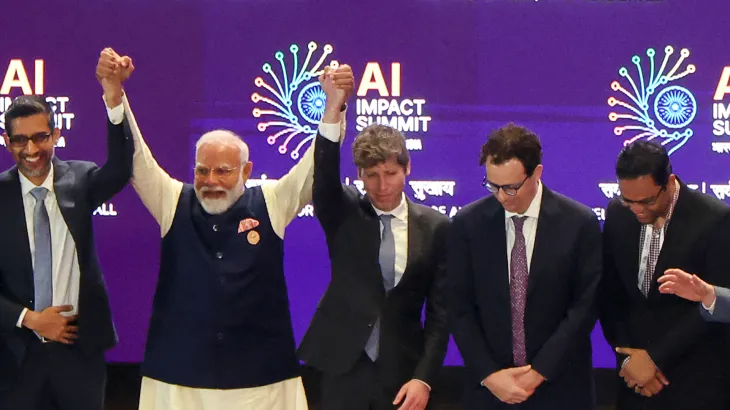
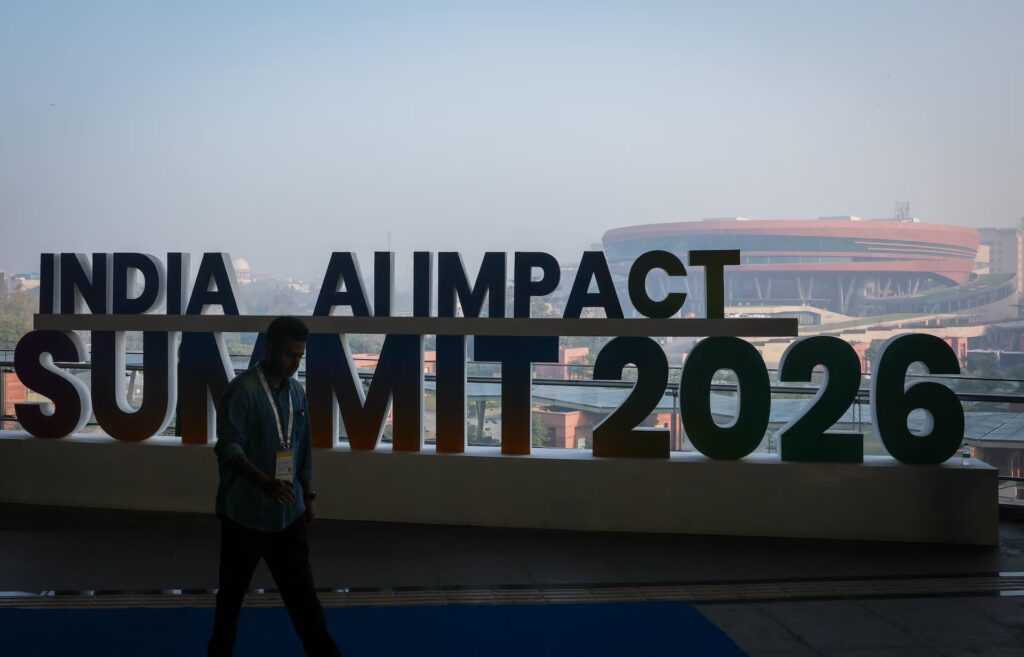
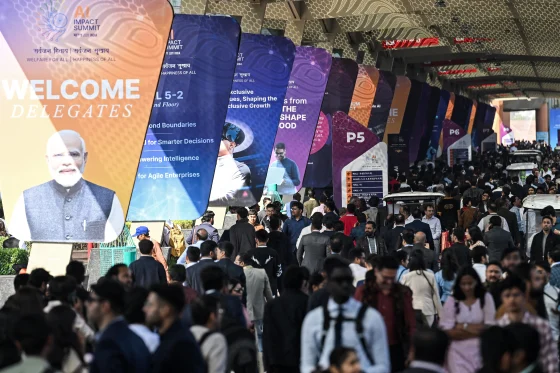
Artificial intelligence influences geopolitics, economics, and daily life. At the India AI Summit in New Delhi, world leaders, tech CEOs, and policymakers gathered to argue about who controls it, how to regulate it, and whether it helps humanity or harms it. The conversations swung between utopian optimism and quiet dread. Everyone agreed on one thing: AI power is impacting the future balance of the world.
The summit revealed deep divisions. Some nations want strict guardrails. Others are pursuing enhanced deployments. Tech leaders warn of existential risks while simultaneously racing to build more powerful systems. Meanwhile, a bizarre controversy involving a mislabeled robot dog reminded everyone that hype still outpaces substance.
What’s Happening & Why This Matters
Sovereignty, Safety, And Strategic Competition
French President Emmanuel Macron frames AI as both an innovation engine and a battlefield. He warns about deepfakes and online abuse, especially involving children. He also argues that AI development must not be concentrated in the hands of a few mega-corporations.
Macron describes AI as “a major field of strategic competition,” noting that large tech firms grow even more powerful as they dominate compute, data, and talent. His solution focuses on “sovereign AI,” meaning systems developed within national or regional frameworks that reflect local laws, values, and environmental priorities. Europe, he insists, pursues innovation without sacrificing safety.
The idea reproduces a blossoming trend. Governments increasingly treat AI like nuclear technology or semiconductor manufacturing. Control equals leverage. Dependence equals vulnerability.
India’s Prime Minister Narendra Modi offers a different tone. He portrays AI as a shared global resource rather than a weapon. He calls for a cooperative roadmap that blends innovation with human values. Modi argues that AI should serve humanity as a whole, not just corporations or powerful countries. He envisions an era where humans and intelligent systems “co-create, co-work, and co-evolve.”
Taken together, these views reveal a philosophical fault line. One side prioritises sovereignty and control. The other stresses openness and shared benefit. Neither side fully trusts the other.
Tech Leaders Sound Both Alarm And Opportunity
If politicians sound cautious, tech CEOs sound conflicted. They build the engines of transformation while warning about their own creations.
Sam Altman of OpenAI pushes for urgent regulation but also champions widespread access. He argues that democratizing AI reduces the danger of any single entity dominating it. At the same time, he acknowledges that powerful safeguards are necessary, just as they exist for other transformative technologies.
Dario Amodei of Anthropic delivers perhaps the most chilling projection. He says AI capabilities have grown exponentially over the past decade and now approach systems that outperform humans across many tasks. He imagines a near future populated by coordinated AI agents operating at superhuman speed — “a country of geniuses in a data centre.”
That metaphor lands with force. It suggests intelligence concentration on an unprecedented scale. Not just smarter tools, but entire ecosystems of synthetic expertise.
Amodei also outlines the double-edged. AI could cure disease, accelerate scientific discovery, and lift millions from poverty. It could also disrupt jobs, amplify misinformation, and create new security risks. India, he says, sits at the centre of these decisions because of its population size, developer base, and growing tech influence.
Even absence carries meaning. Bill Gates was scheduled to deliver a keynote but withdrew at the last moment without explanation. In diplomacy, silence often speaks louder than words.
A Robot Dog Scandal Reveals The Hype Machine
While leaders debate civilisation-scale questions, the summit also produces a more human story — equal parts comedy and cautionary tale.
A university exhibition booth features a robotic dog presented as a local innovation. Online observers quickly identify it as the commercially available Unitree Go2, a Chinese product costing roughly $1,600. The university eventually admits the display did not represent original research.
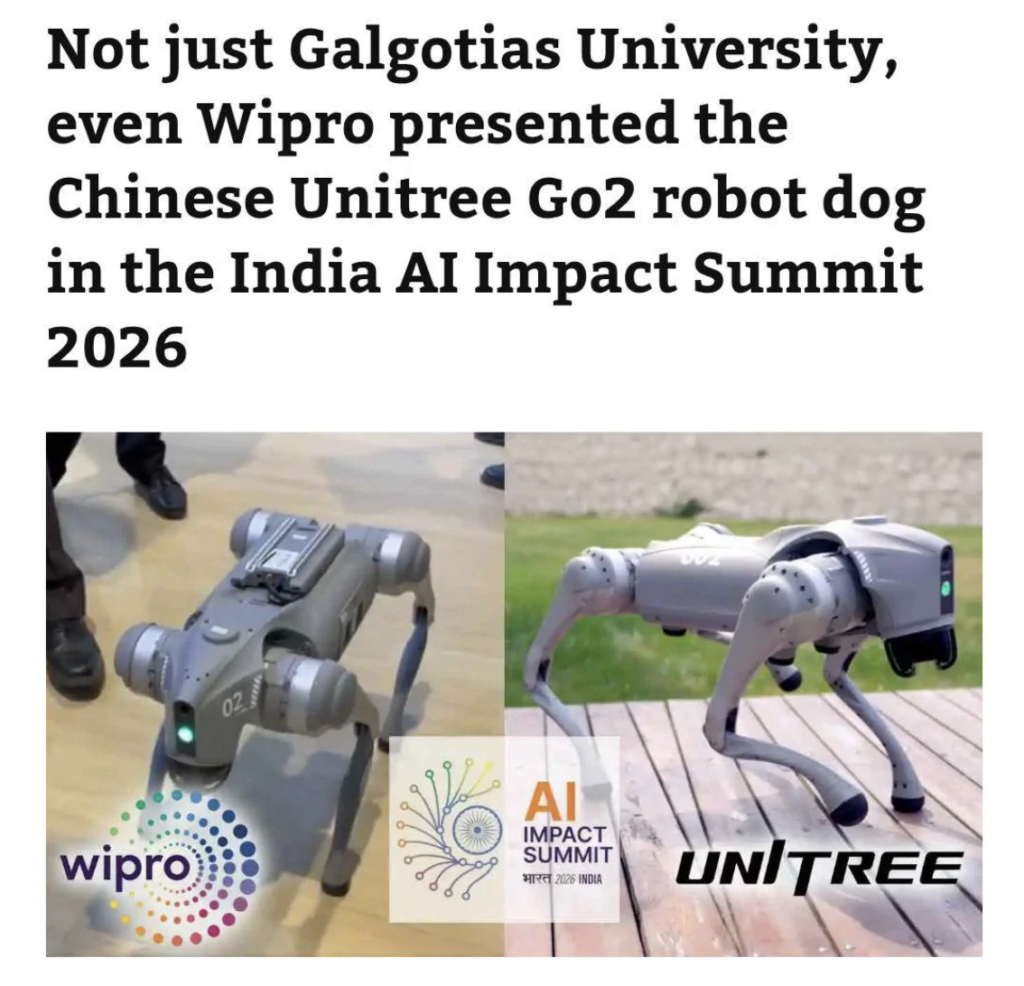
The institution claims no intent to mislead. A spokesperson explains that staff misunderstood the product’s origin. The professor involved says she only meant to inspire students. Government officials reportedly describe the incident as embarrassing.
The episode illustrates a persistent reality: AI buzz creates pressure to appear innovative even when true breakthroughs are scarce. It also exposes how global supply chains blur national ownership of technology. A robot built in China, displayed in India, and scrutinised by the internet is a geopolitical object.
More commonly, the story recalls the performative side of tech conferences. Grand visions coexist with marketing theatrics, startup theatre, and occasional reality checks.
Fragmentation Instead Of Consensus
Despite the summit’s goal of building a unified governance framework, consensus is elusive. Last year’s meeting in Paris already showed regulatory fragmentation. This year confirms the divide persists.
Western democracies worry about safety, ethics, and election interference. Emerging economies note access, growth, and digital inclusion. Tech companies push for flexible rules that allow rapid development. Security agencies quietly assess military implications.
The result resembles a cosmic negotiation where every actor speaks a different dialect of the same language. Everyone says “responsible AI,” but definitions vary wildly.
One subtle tension lies in data ownership. Countries want AI systems trained on their citizens’ information to benefit domestic economies. Meanwhile, multinational firms prefer global datasets that maximise performance. The conflict resembles earlier battles over oil, rare earth minerals, and internet governance.
Another fault line concerns labour. Automation promises productivity gains but threatens employment in sectors ranging from customer service to software development. Governments must balance economic competitiveness with social stability.
Why This Summit Matters Beyond Headlines
At first glance, a diplomatic conference seems remote from daily life. In reality, the policies shaped here influence everything from search engines to medical tools to national security.
If nations fail to coordinate, competing AI ecosystems may emerge. Think parallel internets, incompatible standards, and technological blocs. Travel between them is harder. Data sharing shrinks. Innovation slows or fractures.
Conversely, too much centralisation risks concentrating power in a handful of corporations or governments. That scenario worries both regulators and civil liberties advocates.
The summit, therefore, is a deeper question: Who gets to design intelligence itself?
Human history has never faced that dilemma before. We invented tools, engines, and networks, but never entities capable of reasoning, learning, and acting autonomously at scale.
TF Summary: What’s Next
The India AI Summit shows that the world agrees on AI’s importance but not on its governance. Leaders call for safety, openness, sovereignty, and innovation — all at once. Tech executives warn of transformative benefits and catastrophic risks. Meanwhile, smaller controversies reveal how hype and reality collide on the ground.
MY FORECAST: Expect a future defined by competing AI alliances rather than a single global framework. Nations will build regional ecosystems, share selectively with trusted partners, and treat advanced models as strategic assets. The technology will spread regardless, because knowledge behaves more like wildfire than currency. The real contest will not be who invents AI first, but who integrates it most wisely into society.
— Text-to-Speech (TTS) provided by gspeech | TechFyle