


Digital Sovereignty or Digital Suppression? Russia’s Messaging Clampdown Expands
Russia is blocking WhatsApp in Russia and pushing millions toward a state-backed alternative. The action comes amid a more comprehensive crackdown on Russian messaging apps that has already affected Facebook, Instagram, X, and Signal. The Kremlin is now targeting the country’s most widely used private messenger.
Officials say Meta violated local law. Meta says Moscow wants to funnel users into a surveillance platform. Meanwhile, Russian citizens scramble for VPNs. And international observers are monitoring closely.
This story sits at the intersection of digital sovereignty, national security, censorship, and platform power. It also signals how governments treat messaging apps as political infrastructure.
Let’s unpack what is happening and why it matters.
What’s Happening & Why This Matters
WhatsApp Is Blocked Nationwide

Russia confirms it has blocked WhatsApp, citing legal violations by Meta, the parent company. The app disappears from the federal regulator’s directory. Service halts for most users.
Kremlin spokesperson Dmitry Peskov states that authorities implemented the decision because Meta refused to comply with Russian law. He does not specify the violation.
Meta pushes back hard. A spokesperson tells the Financial Times:
“Today the Russian government has attempted to fully block WhatsApp in an effort to drive users to a state-owned surveillance app. Trying to isolate over 100 million people from private and secure communication is a backwards step.”
That’s a significant number. More than 100 million users once relied on WhatsApp in Russia.
The block is not a minor policy tweak. The crackdown is digital isolation on a national scale.
Max Emerges As The State Alternative

Russia directs citizens to download Max, a state-backed messaging platform. Officials describe Max as “an affordable alternative” and “a developing national messenger.”
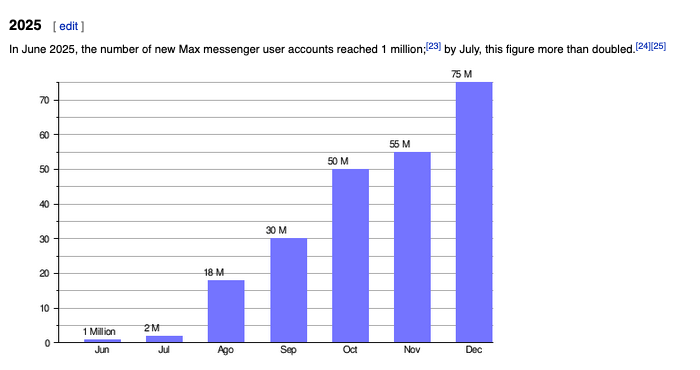
Max comes pre-installed on new devices sold in Russia. It reportedly has more than 55 million users.
Max mirrors China’s WeChat model. It combines messaging, voice calls, payments, and government authentication into one ecosystem. Critics warn that the app lacks strong encryption and includes extensive tracking capabilities.
State media claims Max does not surveil users. Independent analysts remain skeptical.
This push reflects a broader strategy: build domestic alternatives and reduce dependence on Western platforms.
Telegram Faces Pressure Too
The WhatsApp block does not happen in isolation. Russia also restricts Telegram, another major messaging platform. Users report slowdowns when downloading images and videos.
Authorities accuse Telegram of refusing to remove content they label criminal or extremist.
Telegram founder Pavel Durov responds publicly:
“Telegram stands for freedom of speech and privacy, no matter the pressure.”
The government already blocked Signal in 2024. The pattern is obvious. Russia narrows the digital field.
VPN Crackdowns Tighten The Net
Some Russian users access WhatsApp via VPN. Yet authorities increasingly restrict VPN services. The Kremlin limits access to hundreds of VPN providers. It also bans VPN advertising.
VPN access determines whether citizens can bypass state filters. Restrict VPNs, and you control the pipes.
Digital containment is more effective when exit routes disappear.

The Political Context
Russia banned Facebook and Instagram in 2022. It later banned X. WhatsApp initially escaped that sweep. Today, it joins the list.
Roskomnadzor, Russia’s communications regulator, previously restricted WhatsApp voice and video calls “to counter criminals.”
Today’s block follows years of escalating control over online speech. Independent media outlets operate under tight limits. Civil society groups face restrictions. Digital platforms once provided alternative channels for organizing and dissent.
Messaging apps function as infrastructure for activism, journalism, and informal networks. When the state controls those channels, it controls visibility.
Why This Impacts Global Tech
The exercise ranges beyond Russia. It indicates how governments worldwide treat private tech platforms.
Three forces collide here:
- National Security Arguments: Governments demand access to data and compliance with content moderation requirements.
- Platform Sovereignty: States want domestic control over digital infrastructure.
- Encryption Tensions: End-to-end encryption protects privacy. It also limits state visibility.
Russia pushes a domestic system that integrates messaging with government identity tools. That design mirrors China’s digital governance model.
Other countries observe this experiment.
What It Means For Meta
For Meta, the loss is both financial and symbolic. Russia represents a large user base. Blocking WhatsApp removes a communication layer once insulated from Facebook and Instagram bans.
Meta argues that isolating users reduces safety. Critics argue that global tech firms face increasing friction in authoritarian markets.
The question is strategic. Does Meta negotiate? Does it exit permanently? Or does it rely on VPN workarounds?
For Russian Citizens…
Citizens face a narrowing menu of communication tools. Many still attempt to use VPNs. However, access fluctuates.
If Max is dominant, the state gains visibility into a huge portion of digital communication. Even without reading encrypted content, metadata patterns reveal networks.
Communication tools shape civic space. Restrict the tools, and you shape habits.
A Digital Power Shift
Russia frames this as legal enforcement. Meta frames it as censorship.
Both narratives reveal a deeper truth: control of communication equals control of influence.
Digital platforms once transcended borders. Governments redraw those borders at the protocol level.
This trend will not reverse soon. Instead, we see a fragmented internet emerging. Different regulatory zones + data regimes = varying platform ecosystems.
The once-global digital commons is fracturing.
TF Summary: What’s Next
Russia blocks WhatsApp in Russia and accelerates its pivot toward domestic digital control. Max continues to expand as the state’s preferred platform. Other platforms face pressure. VPN access tightens, causing citizens to adapt.
In the near term, users search for workarounds. In the medium term, domestic apps gain traction. Over time, Russia deepens a sovereign internet model that mirrors China’s structure.
MY FORECAST: Expect more countries to test platform bans during periods of political stress. Expect more “national messenger” projects. And expect global tech companies to face harder choices between compliance and exit.
Digital borders count as much as physical ones.
— Text-to-Speech (TTS) provided by gspeech | TechFyle