



A Model Built for Professional Work
Artificial intelligence spent years promising productivity. In late 2025, that promise started to feel uncomfortable. OpenAI released ChatGPT 5.2, its most advanced model series yet, and framed it plainly: this system targets real professional work. Not demos. Not toys. Actual jobs.
The release arrived weeks after GPT-5.1 and months after GPT-5, during a period of intense competitive pressure following Google’s Gemini 3 breakthroughs. OpenAI insists timing alone does not explain the launch. Even so, the message lands clearly. AI now competes directly with human knowledge workers.
The release confronts a more complicated question. Can ChatGPT 5.2 do your job better than you? Or, more accurately, can it do enough of your job to change how employers define value?
What’s Happening & Why This Matters
OpenAI positions GPT-5.2 as its strongest model family for professional knowledge tasks across 44 occupations, ranging from software engineering and finance to research, analysis, and operations. Unlike earlier releases that emphasised creativity or conversational polish, GPT-5.2 focuses on execution.
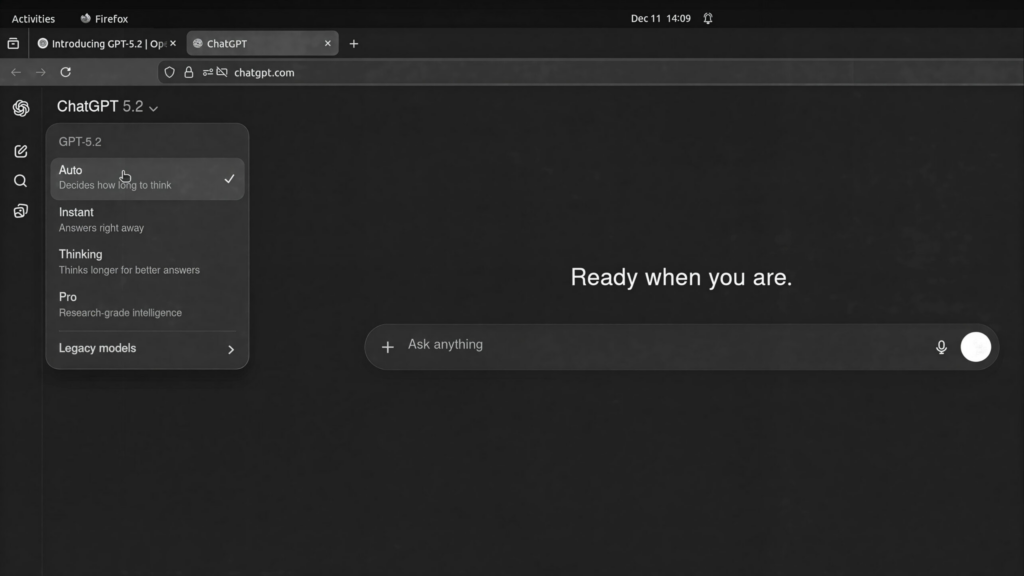
The model ships in three variants: Instant, Thinking, and Pro. The Thinking version handles multi-step reasoning, longer workflows, and higher-stakes decisions. OpenAI frames this variant as the core engine for workplace use, especially when paired with human oversight.
The shift feels deliberate. This release moves away from novelty and toward substitution.
Illuminating Benchmarks
OpenAI avoids splashy side-by-side marketing on its website. Still, numbers shared privately with press outlets tell a sharper story. On SWE-Bench Pro, a respected software engineering benchmark, GPT-5.2 Thinking scores 55.6%, outperforming Gemini 3 Pro and Claude Opus 4.5.
On GPQA Diamond, which tests graduate-level science reasoning, GPT-5.2 edges past Google again. More striking, OpenAI claims the model beats or ties human professionals on 70.9% of tasks in its internal GDPval benchmark, a system designed to simulate real-world workplace assignments across dozens of roles.
Speed and cost numbers amplify the impact. OpenAI says the model completes these tasks at over 11 times the speed and under 1% of the cost of human experts. These claims deserve scepticism. Even OpenAI acknowledges that the benchmark favours vendors. Independent verification remains pending.
Still, direction matters more than decimals. AI performance trends upward. Human advantage narrows.
Fewer Hallucinations, Higher Trust
One long-standing weakness receives attention. GPT-5.2 reportedly generates 38% fewer confabulations than GPT-5.1, according to OpenAI’s post-training leadership. Reduced hallucinations matter deeply for enterprise adoption. Accuracy unlocks trust. Trust unlocks delegation.
This improvement changes risk calculations for managers and executives. Tasks once double-checked now receive lighter oversight. Some may require none at all.
Not a Job Killer — Yet
OpenAI leaders strike a careful tone. CEO Sam Altman openly admits GPT-5.2 cannot output fully polished files or replace humans end-to-end. Instead, the company frames the model as a multiplier. Enterprise customers report saving 40 to 60 minutes per day, translating to 10+ hours per week for power users.
That framing feels diplomatic. Productivity gains of that scale rarely remain neutral. Organisations reallocate time. Roles compress. Teams shrink. History suggests efficiency eventually rewrites headcount.
The Roadmap
The release follows OpenAI’s internal “code red” moment triggered by Google’s Gemini 3 progress. Executives deny rushing GPT-5.2. Still, they admit resources shifted aggressively toward ChatGPT after the competitive shock.
This context matters. AI capability now advances inside a pressure cooker. Each major vendor races to redefine professional value before regulators, unions, or governments respond.
TF Summary: What’s Next
ChatGPT 5.2 does not steal jobs overnight. It does something subtler and more powerful. It reshapes what counts as work. Tasks that once defined roles now feel automatable — judgment, oversight, and accountability climb in importance. Execution drops in value.
MY FORECAST: Over the next year, organisations will stop asking whether AI replaces jobs. They ask which humans remain essential once AI handles everything else. Workers who adapt thrive. If you wait too long, you struggle.
— Text-to-Speech (TTS) provided by gspeech