


Software development is faster each year, yet deployments are still a messy business. For many, Amazon Web Services, the global leader in cloud services and applications, is one of the trickiest environments. Teams build full-stack React apps in hours, then lose days wiring AWS resources, securing Virtual Private Clouds (VPCs), setting Identity and Access Management (IAM), configuring databases, and aligning cloud components. The gaps slow shipping velocity, drain product energy, and tax the resources themselves.
Enter /monolayer/ to seal the gaps. The platform builds an automation layer that turns React or Next.js code into production-ready AWS infrastructure. It provisions databases, message queues, background tasks, storage, Lambdas, Elastic Container Service (ECS) jobs, VPC isolation, and CloudFront delivery — directly within a user’s AWS account.
No lock-in, YAML, or IaC drift. No DevOps hire required. Developers code. /monolayer/ ships.
What’s Happening & Why This Matters
Automated Infrastructure for Modern Web Apps
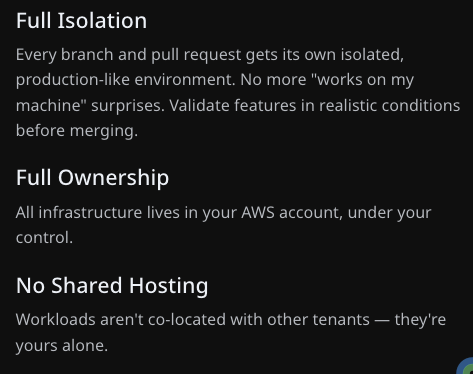
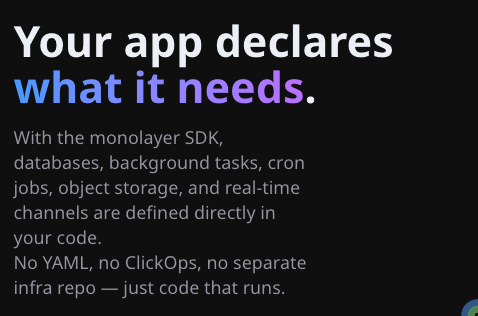
/monolayer/analyses full-stack React and Next.js apps, then creates AWS infrastructure with secure defaults. This includes PostgreSQL, Redis, DynamoDB, Lambda, ECS Fargate, CloudFront, S3, and private subnets inside a VPC.
All resources live inside a customer’s AWS environment, giving teams full control with native cloud reliability.
Developers can transition from local builds to production deployments in minutes. /monolayer/ removes infra friction, boosts confidence, and opens new speed for small engineering teams.
User-Controlled AWS Without Vendor Lock-In
Platforms like Vercel, Netlify, and Supabase create speed yet introduce control limits. /monolayer/ runs inside the customer’s AWS account, so teams use familiar AWS tools and avoid migration pain later.
/monolayer/’s model appeals to product teams, venture studios, and agencies that want fast delivery and long-term control.
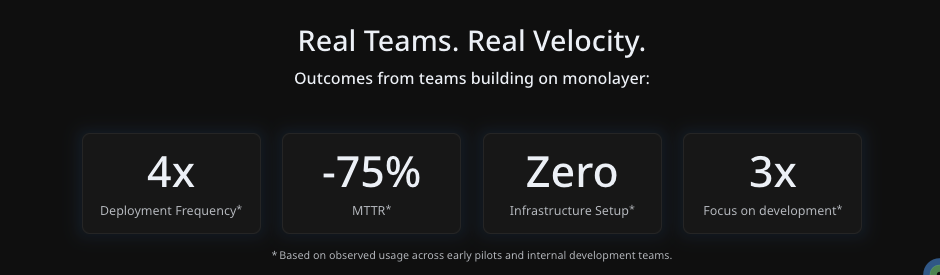
Traction and Momentum
/monolayer/ enters its public beta with heightened interest from developers after faster pipelines. The founding team — Marc (a full-stack veteran) and Dani (a scaling and growth expert) — is pursuing seed funding while gathering product data and user insights.
The current roadmap includes full-stack components, instant rollback, unified logs, RBAC, branch protection, and expanded framework support.
TF Summary: What’s Next
/monolayer/ enters a high-velocity chapter. The team is recruiting developers through public beta programs, user groups, and partner channels. Feedback loops refine the product and steer seed investment decisions. For business inquiries, contact [email protected]; media inquiries reach [email protected].
Developer demand for tools that maintain AWS control while reducing DevOps overhead is growing. /monolayer/ stands in that space, ready for enterprise accounts, advanced observability, and deeper framework support.
MY FORECAST: /monolayer/ attracts strong early traction as React and AWS adoption increase. Developer pain around DevOps remains high, and teams want reliable, frictionless paths from code to cloud. With momentum and user data, /monolayer/ completes a strong seed round, setting itself as a core automation tool for modern full-stack teams.
— Text-to-Speech (TTS) provided by gspeech